The Double Agent
A northeasterly blizzard raged on the night of April 6, 1942, when the German submarine U-252 surfaced in Finnafjörður near Langanes. That year, the Battle of the Atlantic was at its peak, and a man was sent ashore from the submarine to spy on the Allies. Equipped with a transmitter and armed with a pistol, he rowed a rubber boat toward the shore, struggling through the surf. He barely made it to land after running aground on a skerry. The submarine sailed south and was sunk with its entire crew eight days later, west of the Bay of Biscay.
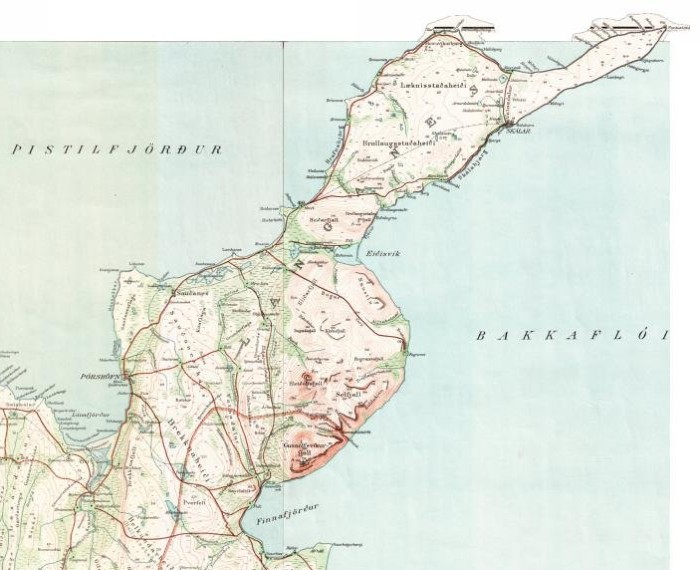
The spy quickly realized that burying the three-meter-long rubber boat in the frozen ground, as instructed, was impossible, so he abandoned it. Using a small collapsible shovel, he managed to hide the transmitter and the pistol in separate holes, carefully memorizing their locations. He then set out to find the nearest farm, nearly succumbing to the severe weather before reaching safety.
Late the next evening, wet, cold, and nearly exhausted, he finally saw the lights of the farm Fell. Had it not been for a birthday celebration in the household that kept the lights on longer than usual, the family would have already gone to bed. In that case, he might have passed by unnoticed and perished in the cold.
The operative was Ib Árnason Riis, an Icelander born in Denmark, where his parents lived. The German intelligence service contacted him with an offer to bring him to Iceland in exchange for a small favor. At first, the task seemed simple: he would deliver a letter in Iceland after being smuggled into the country through Lisbon and New York.
Unemployed and hoping for better prospects in Iceland, Ib accepted the offer, thinking he could simply choose not to deliver the letter. However, the plan changed. He was now promised his own ship in exchange for smuggling a passenger ashore unseen.
Eventually, the plan evolved into traveling to Iceland by submarine and conducting espionage there. Throughout the process, he was continuously given money. By the time he fully understood what was happening, he felt it was too late to back out. He was now in debt, and the German intelligence agents frequently reminded him that they knew where his parents lived.
The Germans initially assigned him the code name HEKLA, later changing it to EDDA. After training in Hamburg to send encrypted Morse code messages, he departed from Helgoland aboard a newly built submarine. The vessel traveled toward Iceland at a depth of fifty meters, and at one point during the journey, depth charges were dropped near them.
Ib was a licensed first mate and was allowed to choose his drop-off location. He selected Langanes for its remoteness. The Germans later used this site at least once more to land another spy.
Having narrowly escaped the harsh weather, Ib found shelter at the farm Fell. Once he recovered, he was taken to the nearest telephone to report his arrival. The British sent a team to retrieve him and held him in Þórshöfn before transporting him to Reykjavík.
In Reykjavík, he was interrogated by a British intelligence officer and voluntarily disclosed everything, explaining that he had been sent by the Germans to spy on the Allies in Iceland. He was later flown back to Langanes to retrieve the transmitter, the codebook, and the cipher key before being taken to Britain. There, he was held in isolation in London for over a week. Frustrated, he felt betrayed, having voluntarily turned himself in and offered his services. Eventually, he was informed that he would become a double agent under the code name COBWEB.
Back in Reykjavík, Ib was given a job at the British Navy’s office as part of the deception. He explained his access to convoy information to the Germans by claiming it came through this position. However, his pay was low, barely covering food and housing. If he wanted to buy clothes, he had to skip meals. As a result, he often wore the same outfit he had on when he arrived—a Norwegian merchant navy uniform that he had altered to resemble a British uniform.
The British immediately began monitoring the frequency Ib was supposed to use to communicate with the Germans and informed him that they had been trying to contact him since his arrival. The deception Ib participated in was part of a larger operation called Double-Cross, which was active throughout the war and extended across Europe. The operation involved turning German spies to work for the British, using them to feed the German intelligence service false information.
Ib was tasked with sending reports on convoys, military forces, and weather conditions. Regarding convoys, he transmitted false messages mixed with some truth. When reporting on the military presence in Iceland, he provided exaggerated information. However, he was forbidden from sharing weather data. When the Germans complained, he claimed that the Allies had confiscated all barometers in the country. As a result, he could not provide information on atmospheric pressure systems over Iceland, preventing the Germans from calculating their impact on the weather in mainland Europe.
Later, another Icelandic agent sent by the Germans turned himself in to the British. He had landed at the same location as Ib, carrying a transmitter and a barometer. He was also turned into a double agent working for the Allies under the code name BEETLE. However, he was not allowed to keep the barometer and likely told the Germans it had been damaged.
In most cases, the British provided Ib with the text to be sent, and he encoded it using the cipher he had been taught, wording it in his own style. However, early in his time as a double agent, he was given a pre-encrypted message to transmit without knowing its contents. In hindsight, he believed it was related to the PQ-17 convoy, which the Germans attacked on July 1, 1942, as it traveled from Hvalfjörður to Arkhangelsk carrying military supplies and equipment for the Soviets.
The convoy lost 24 out of 35 ships, and its fate became a scandal when it was revealed that its naval escort had been recalled, leaving it defenseless against German aircraft and submarines. Survivors and the families of those lost have long claimed that the convoy was used as bait to lure the battleship Tirpitz out of port when the Allies were prepared to sink it. However, the plan failed as Tirpitz turned back to its harbor in Norway after setting out.
Ib believed that another purpose of the operation was to build German trust in his messages. The Germans thanked him warmly for the information about PQ-17 and even promised him a bonus payment. Five months later, false intelligence successfully lured the battleship Scharnhorst out, and it was sunk by the Allies.
In 2003, wartime intelligence documents were declassified, suggesting that Ib was suspected of having warned the Germans. He was blamed for revealing too much in the aforementioned message, allegedly causing Tirpitz to turn back. When The Sunday Times contacted him about this, he reacted angrily, stating that he had never known what was in the message. He believed they were searching for a scapegoat and said he intended to demand a correction from the British authorities.
Ib served in G-2, the joint British and American intelligence network, from 1942 to 1945 until the war’s end. When he left, he received no reward or recognition from the British aside from confirmation of his employment in the office. Not even a ticket back to Denmark. The Americans were more helpful, and the head of U.S. intelligence in Iceland provided him with recommendations when he eventually moved to the United States, where he lived for the rest of his life.
Ib Árnason Riis always felt he had been treated unfairly but took comfort in knowing that many believed his radio transmissions had saved the lives of numerous sailors.
He never returned to retrieve the pistol he had buried in Finnafjörður. However, on the discussion forum Gentleman’s Military Interest Club, an Icelander named Hinrik claimed to have been in contact with Ib when he was in his nineties. Hinrik had received a more precise location from him and planned to search for the pistol using a metal detector. But there has been no report of it being found, so it may still lie buried wrapped in oilcloth.
Sources in English
- Convoy PQ-17. Wikipedia
- Double cross system (2000). John Cecil Mastermann
- Failed MI5 Tirpitz plot cost 24 ships. The Sunday Times, May 25th 2003
- German battleship Scharnhorst. Wikipedia
- German battleship Tirpitz. Wikipedia
- U-boat Spy EKI and EKII. Gentleman’s Military Interest Club
Sources in Icelandic
- Bretar grunuðu íslenskan gagnnjósnara sinn um svik. Morgunblaðið, 26. maí 2003
- Gagnnjósnari Breta á Íslandi (1991). Ásgeir Guðmundsson
- Seyðfirskir hernámsþættir (1977). Hjálmar Vilhjálmsson
- Skipaskaði rakinn til íslensks njósnara. Fréttablaðið, 26. maí 2003