The Monster of Kleifarvatn
Near Hafnarfjörður on the way to Krýsuvík lies Kleifarvatn, the third-largest lake in South Iceland and one of the deepest lakes in the country. It is mentioned in the book Travels in Iceland by Eggert Ólafsson and Bjarni Pálsson, where they recount tales from locals who saw and feared strange creatures in the lake. A more recent story involves a bird hunter and his nephew who also saw unknown creatures in the water and ashore.
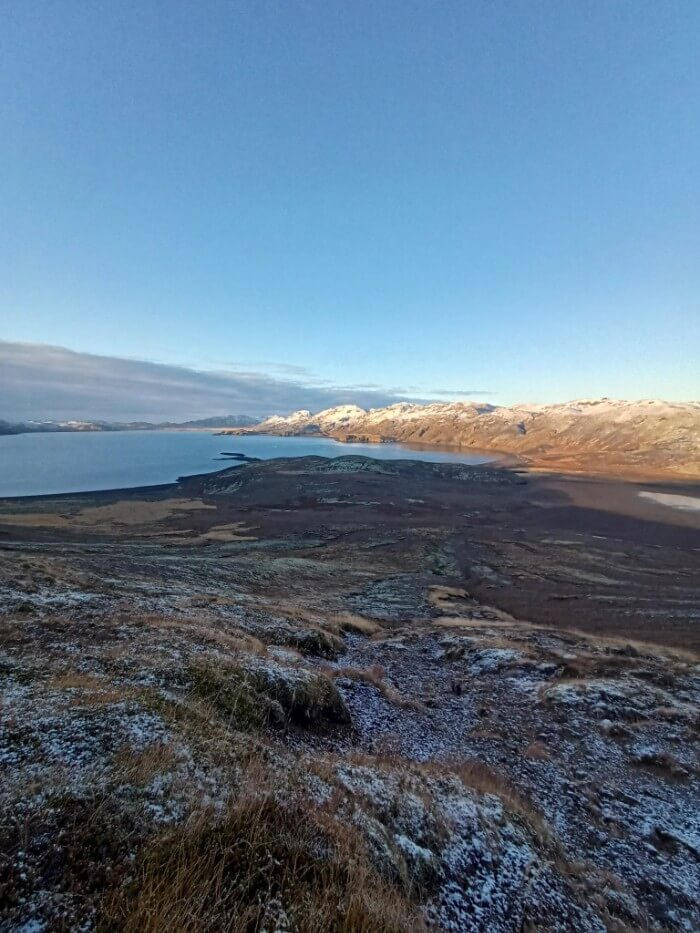
In 1750, during their journey through Iceland to gather information for the Danish Scientific Society, Eggert and Bjarni visited the lake. Their guide told them that in August of the previous year, people haymaking by the lake saw a huge black worm emerge and crawl onto a narrow rocky spit. The people were afraid and dared not approach the worm, but since it remained still, they didn’t flee. Instead, they watched in fear as it lay basking in the sun for two hours.
The description of the worm’s movements resembles that of an earthworm, contracting and arching itself, then stretching out again. The rocky spit referred to might be the one that juts into the lake at its northeastern end, near where the ptarmigan hunters saw a different kind of creatures over two centuries later.
Eggert and Bjarni were also told that the lake was full of fish but that locals dared not go out on it for fear of the worm. Their guide claimed to have seen it many times, both alone and with others, and it stayed visible long enough for him to observe it well.
Five years later, a man told them he had recently seen a creature swimming on the lake’s surface that was shaped and colored like a skate but massive in size.
Nearly two and a half centuries passed until strange animals were seen again at Kleifarvatn, at least according to records. On October 27, 1984, on a Saturday morning, two ptarmigan hunters, Júlíus Ásgeirsson and his nephew Ólafur Ólafsson, were on Vatnshlíð slope on the eastern side of Kleifarvatn.
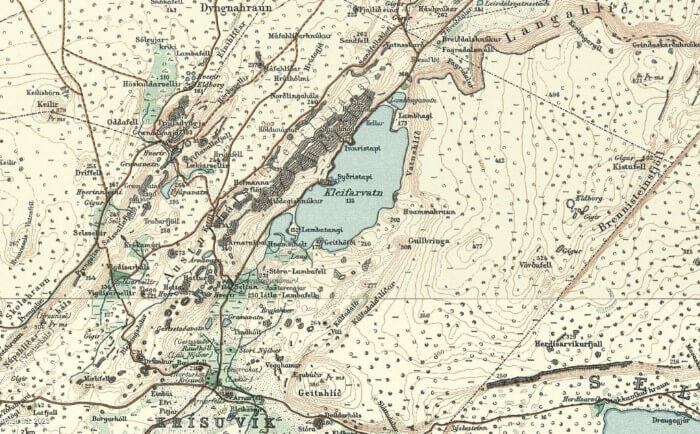
They were high up on the slope above Lambhagatjörn, a pond that once lay near the lake but has mostly disappeared today. They noticed two dark spots just beyond the strip of land that separates Kleifarvatn from the pond and initially thought they were rocks. Then the spots began to move, revealing themselves as two animals swimming, which then climbed onto the strip between the lake and the pond and into Lambhagatjörn. They emerged again on the innermost eastern shore, where they briefly paused and disappeared behind a mound, then reappeared and entered the pond again, exiting on the western shore. They then climbed into a gully on the Sveifluháls ridge, that lies along the opposite shore of Kleifarvatn and vanished from sight. When the men later returned to the pond, they saw tracks resembling paw prints, with three bowl-shaped impressions on each of the four feet.
Júlíus, who was interviewed by DV and Fjarðarpósturinn, passed away in 2017. In his obituary, he is described as a trustworthy and truthful man.
If he had wanted to invent such a story, one would think he would have claimed to have seen a giant worm or skate, as described in Eggert and Bjarni’s book, rather than two animals resembling seals in the water and horse-sized dogs on land.
In the interview with Fjarðarpósturinn, he said he always mocked stories of monsters and similar phenomena and never intended for this to become public, but he couldn’t resist telling a friend who was a journalist at DV, and thus the story ended up in the newspapers.
If the truth of these stories from both the 18th and 20th centuries is not in doubt, if the witnesses truly saw something akin to what they described, and if fantastical explanations such as time travel or interdimensional crossings are ruled out, the most plausible guess might be that these were individuals of otherwise extinct ancient animal species.
The reason no bones have been found of such creatures could be that worm-like creatures resembling giant earthworms would be boneless mollusks, and skates have cartilage rather than bones. Bones also do not preserve well unless in ideal conditions, such as very dry, cold, or oxygen-poor environments.
The description of the creatures the bird hunters saw resembles how scientists believe early whale ancestors looked like. These were about the size of an Icelandic horse and appeared similar to oversized martens or otters.
Sightings of monsters at Kleifarvatn are less frequent than they were in the 18th century, but it’s still worthwhile to visit the site to experience the environment and nature.
For anyone seeking to find a monster in the lake, if it or they still exist, an underwater drone exploring the areas around the hot springs at the bottom might yield the best results, as one would expect the most life and food there.
Those more spiritually inclined could attempt to sense or connect with these creatures in a meditative state. A good place for meditation in fine weather would be on the strip between the lake and the pond where the animals crossed, or higher up on either side of the lake at Vatnshlíð or Sveifluháls, where there’s a good view.
Sources in English
- Kleifarvatn. Wikipedia
- Travels in Iceland (1975). Eggert Ólafsson et al.
Sources in Icelandic
- „Feginn ef einhver gæti gefið á þessu gáfulega skýringu.“ Fjarðarpósturinn, nóvember 1984
- Ferðabók Eggerts Ólafssonar og Bjarna Pálssonar (1974). Eggert Ólafsson et al.
- Júlíus Óskar Ásgeirsson. Morgunblaðið, 2. maí 2017
- Skrímslafrétt DV í beinni útsendingu í Bandaríkjunum? DV, 17. nóvember 1984
- Skrímsli við Kleifarvatn. Ferlir
- Tvö skrímsli í Kleifarvatni? DV, 2. nóvember 1984