The Roman Coins
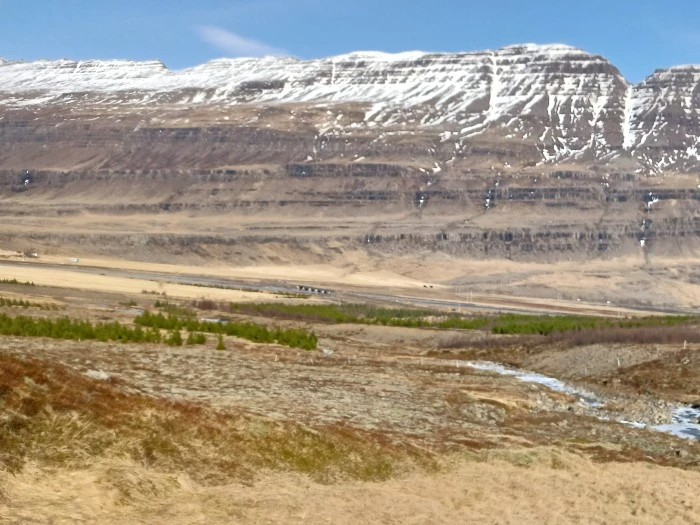
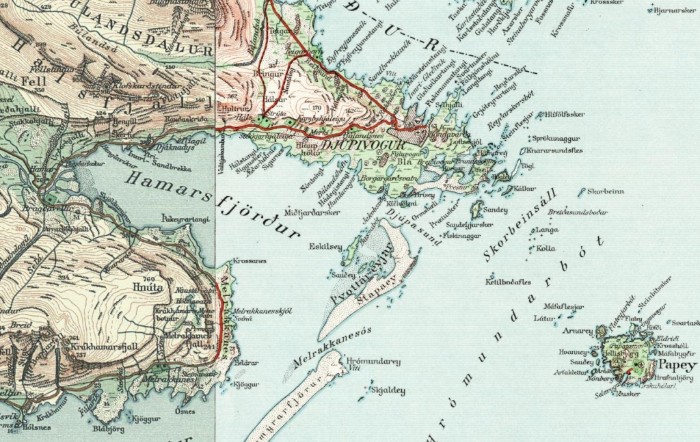
In the East Fjords, three Roman copper coins have been discovered. Two of them were found near the farm of Bragðavellir in Hamarsfjörður, in the ruins of a settlement believed to date back to the Age of Settlement. One was found about 25 kilometers further south, on the sands between Hvalsnes and Krossanes. The discovery of Roman coins of this type is very rare in the Nordic countries, as they had no value due to their low silver content.
Roman copper coins have mainly been found in archaeological excavations in former Roman territories, but in the Nordic countries, almost exclusively Roman coins made of silver and gold have been found.
More than a thousand years before Iceland was settled by Norsemen, the Greek explorer Pytheas sailed the North Atlantic and described the island of Thule or Thile, which many believe to be Iceland. The Romans were aware of these writings and thus knew of this island when their empire extended to Britain, many centuries after the Greek seafarer wrote his account.
In chronological order of the discovery of the Roman coins, the first of these three was found in 1905 by the farmer Jón Sigfússon. It was found in Djúpibotn near the farm of Bragðavellir were the ruins of a farm from the Age of Settlement, but they have almost completely disappeared today due to erosion. In this area, farmer Jón began finding archaeological artifacts exposed by the loss of topsoil. First, a stone with a hole, then half of a red glass bead from a necklace. Then this coin, along with iron fragments and pottery shards made of soapstone, likely of Norwegian origin. Ancient artifacts continued to be found in the area from time to time, such as beads and colored pebbles. The coin found that year dates from the time of Probus, who was Emperor of Rome from 276 to 282. It is described as not perfectly round, just under 2 centimeters in diameter, and quite worn.
The second coin was found by an English teacher named Leonard Hawkes in 1923, on the sands at the mouth of Hvaldalur, between Krossanes and Hvalsnes. This coin dates from the time of Emperor Diocletian, who ruled from 284 to 305. It is about 2.5 cm in diameter, and some of the inscription on it has become illegible.
The third coin was likewise found by farmer Jón in 1933, 28 years after he discovered the first one. This coin dates from the time of Emperor Aurelian, who ruled from 270 to 275, and has a diameter of 2 cm. Some of the inscription has worn away.
Coins of this type are called antoniniani, named after the emperor who first had them minted, Marcus Aurelius Severus Antoninus (188–217), better known by his nickname Caracalla. They were initially made of silver, but over time cheaper metals were increasingly mixed in, so that by the end of the third century, they had become copper coins with a slight silver sheen.
The main explanations for the presence of Roman copper coins in Iceland are primarily four, and these possibilities will now be reviewed in reverse chronological order, starting with the one closest to us in time.
The first theory put forward is that it might be a hoax, that the coins were planted by those who claimed to have found them. However, this is considered rather unlikely. The finders either had nothing to gain or everything to lose by engaging in such deception, as their reputations were at stake. Farmer Jón Sigfússon lived under harsh conditions at Bragðavellir, in a dilapidated house, and was very ill the year he found the first coin. Despite this, he made no attempt to profit from the discovery. His interests also leaned more towards geology than history, making it likely that he found the coins while pursuing his geological interests. The English teacher was also described as a very respectable man, not known for any kind of pranks, and later went on to achieve some distinction in his academic field.
The second theory is that Norse settlers brought the coins with them. This is the explanation preferred by Icelandic archaeologists today. Kristján Eldjárn, a doctor of Archeology and later President of Iceland, writes in his book Gengið á reka (Gathering Driftwood) that he believed it was most probable that the Romans themselves brought the coins, though he is later said to have withdrawn that hypothesis. As he notes, it would have been strange for the settlers to carry worthless coins with them. However, perhaps they were kept as souvenirs, or someone may have been tricked into accepting them as currency, as has been suggested. Even though such coins have rarely been found in the Nordic countries, they are quite common in Britain.
Although two of these three coins were found in the ruins of houses and among artifacts that are undoubtedly from the Age of Settlement, this does not necessarily mean that the settlers brought them to Iceland. It is possible that they discovered the coins after arriving in the country, like Mr. Hawkes did a thousand years later.
The third theory is that the Irish hermit monks, who were on the island when the Norse settlers arrived according to Landnámabók, brought the coins with them. However, this is considered unlikely, as the monks avoided the use of money in accordance with the customs of holy men. Moreover, such Roman copper coins were very rare in Ireland, which was never under Roman rule.
The fourth theory is that the coins were brought to Iceland by the Romans themselves. At the time these coins were minted, Britain was under Roman rule, having been so since the year 42 and remaining so until the 5th century. It was usually under the direct control of the Roman Emperor, but for a while it was held by the military commander Carausius, who rebelled against Rome, seizing control of Britain and parts of Gaul, and declared himself Emperor of the North. By then, the Roman Empire had already been divided into the East and West Empires.
At that time, Roman warships were dispatched from both France and Britain to hunt down pirates and secure trade routes, which is how Carausius originally rose to prominence. The three coins were in circulation during his era, and it is possible that a Roman ship was blown off course by a storm from the waters northwest of Britain to Iceland, much like the Dutch treasure ship that ran aground on Skeiðarársandur many centuries later.
Another possibility is that an exploratory expedition was undertaken based on the writings of the Greek explorer. Perhaps the usurper emperor Carausius was preparing a contingency plan in case he was driven out of Britain and had heard of the northern island discovered by Pytheas. The coins could then have been part of a larger treasury brought along with the intention of establishing a Roman economy in a new location, as the Romans did wherever they settled.
Whether by accident or intention, if a Roman ship did indeed make its way to Iceland, it could have been wrecked off the coast of the East Fjords. These Roman small coins might have been the only things both light enough to be washed ashore during a severe storm and durable enough to be found buried in the shoreline during the Age of Settlement six hundred years later, and then again, nine hundred years after that.
Whatever the explanation, it remains a mystery how these Roman coins found their way to Iceland. This is clearly a case where an archaeologist would greatly benefit from the gift of psychometry.
Sources in English
- Marcus Aurelius Mausaeus Carausius. Britannica
- Pythes. Wikipedia
- Roman coins in Iceland (B.A. thesis 2010). Davíð Bjarni Heiðarsson
Sources in Icelandic
- Árdagar Íslendinga (2016). Guðmundur Garðar Þórarinsson
- Gengið á reka (1948). Kristján Eldjárn
- Hverjir fundu Ísland? Grúsk (1970). Árni Óla
- „Mér þýðir ekki að kvíða.“ Múlaþing, 1984