Sæmundur the Learned
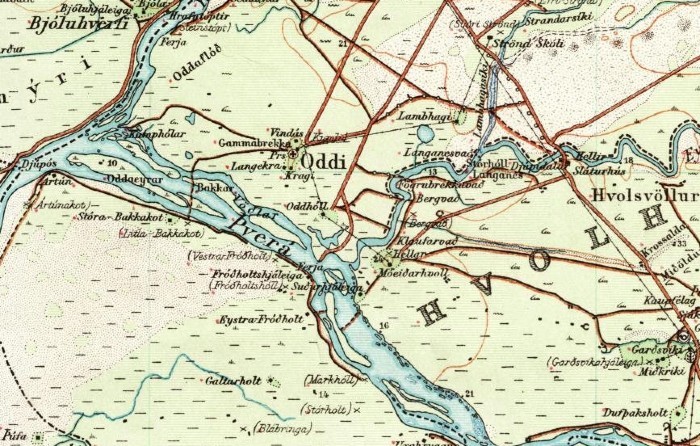
Sæmundur Sigfússon the Learned, was born in 1056 and is the patriarch of the Oddaverjar clan, one of the more notable chieftain families of the Sturlung Era. He was a highly respected cleric and scholar, influential within the Church, and an advisor to the bishop. He is also Iceland’s best known sorcerer.

It may seem contradictory for a priest to also be a sorcerer, but this was not unprecedented, neither in Iceland or mainland Europe, whether shortly after the adoption of Christianity or in later periods. In Icelandic folklore, other priests were also said to have practiced magic, but Sæmundur the Learned is the oldest.
It may also seem unusual that a Catholic priest like Sæmundur would become the patriarch of a clan. But celibacy of priests at this time, was not yet strictly enforced by the Pope, and Sæmundur had three sons and one daughter.
It is not known how old Sæmundur was when he went abroad to study, but it would have been between the ages of 14 and 20. According to legend, he studied magic at the Black School, where the Devil himself was the headmaster, and had to use a magical trick to escape upon completing his studies. The story of his escape is originally a French folktale and refers to Gerbert of Aurillac, later Pope Sylvester II, escaping from his Moorish teacher after stealing a forbidden book.
When discussing the historical figure of Sæmundur the Learned and his reputation as a sorcerer, it is often explained away by stating that all educated men of the time were believed to possess magical abilities. However, the truth is more complex and intriguing.
It is most likely that Sæmundur studied in France, possibly at more than one school, as students started doing at the time. It is certain he studied law and canon law, literature, astronomy, Latin, logic, and likely natural sciences and medicine. During his education in a French monastery, he would not have had to look far for a cleric scholar role-model with reputation as a sorcerer.
That person was aforementioned Gerbert of Aurillac, who took the name Sylvester II upon being elected Pope. He lived a century before Sæmundur and was rumored to have recieved help from the Prince of Darkness to secure his position. It is possible that Sæmundur studied under a teacher, who in turn studied under another, and so on in a lineage that traced back to Gerbert.
It is highly unlikely that Sæmundur the Learned would not have studied what is today called occultism or magic. He would not have earned his nickname had he not, as the existence of magic and the supernatural was at the time a known fact.
Sæmundur spent longer abroad than planned, about eight years, and might not have returned to Iceland if not for his childhood friend Jón Ögmundsson, who sought him out and persuaded him to return. According to legend, Sæmundur had become so bewildered that he could no longer remember his own name.
In The Folklore Collections of Jón Árnason and The Folktales of Ólafur Davíðsson among others, there are numerous stories about Sæmundur, and he is best known from these. However, it is not only in folklore that Sæmundur is documented as possessing supernatural abilities. Hungurvaka, a work about Iceland’s first five bishops, mentions Sæmundur as being “forvitri,” meaning he could foresee future events, interpret dreams, or had clairvoyant abilities.
In the Saga of Bishop Jón Ögmundsson, the first Bishop of Hólar, it is noted that Sæmundur excelled in astronomy, which during the Middle Ages was indistinguishable from astrology. Thus, it is fair to say that Sæmundur the Learned was at least an astrologer.
Gerbert of Aurillac, before becoming Pope, traveled to Spain, where he studied under Arabic teachers and learned to read Arabic. Most, if not all, of the sciences of the early Middle Ages came to Europe from the Islamic world, which encompassed half of Spain. These included mathematics, chemistry, medicine, and astronomy. Gerbert promoted Arabic science and facilitated the translation of Arabic texts into Latin.
Islamic scholars had preserved the knowledge of the ancient Greeks and Romans, which had been lost in Europe after the fall of the Western Roman Empire. During the Islamic Golden Age, scholars also gathered knowledge from China, Egypt, and other cultures. Mystical traditions from these regions blended with local practices and there were schools and centers dedicated to their study.
In addition to this knowledge, literary influences also spread inside Europe. The tales of One Thousand and One Nights began to be compiled during Sæmundur’s lifetime, though they were not translated into French or other Western languages until half a millennium later. However, there are intriguing parallels between these stories and the folklore about Sæmundur the Learned.
In Icelandic folklore, Sæmundur often makes pacts with the Devil, tricking him and escaping payment, which is usually himself or his soul. Sometimes, Sæmundur even manages to trap the Devil in a small hole. This theme is most common in tales about Sæmundur and rare in stories of other Icelandic sorcerers.
In One Thousand and One Nights, there are many tales of spirits called jinn or djinn, with whom humans make pacts to gain their service or secure a favor in exchange for freeing them from captivity. The most famous of these is the story of Aladdin and the Magic Lamp. It is quite possible that Sæmundur heard similar stories while abroad, which he adapted back in Iceland and retold with himself as the protagonist, as he was a great storyteller and performer.
During the Middle Ages, there were no clear distinctions between mysticism, science, and religion. As previously mentioned, medieval astrology and astronomy were considered the same field of study. Similarly, there were blurred lines between medicine, biology and necromancy, same with alchemy and chemistry. Natural sciences and mysticism were often categorized together, except for the invocation of evil spirits, demons, and other dark entities, which was especially forbidden.
In the 11th century, the Church excommunicated those caught practicing sorcery but didn’t take it any further than that. It was not until centuries later that the Church started executing people for such sins. There was also some tolerance for the occult practices of society’s elite, who, then as now, were often exempt from rules that applied to others. Clergy belonged to the ruling class, and in early Iceland, chieftains were often also priests.
It can be said that Christianity is a socially accepted and institutionalized form of mysticism. The ritual of the Eucharist, involving the symbolic consumption of Christ’s body and blood, closely resembles a magical ceremony from an external point if view. And is there a significant difference between praying to angels, saints, or the Son of God versus invoking other unseen forces?
Although Sæmundur was reportedly highly intelligent and trained in logic, this does not preclude a belief in magic or the occult. Not any more than Isaac Newton, one of the fathers of modern science, who in the 18th century studied alchemy, numerology, Hermeticism, and esotericism. Other prominent scientists closer to our time, such as Albert Einstein, Thomas Edison, and Nikola Tesla, also showed an interest in the supernatural.
The Church’s ban on sorcery was arguably a means of monopolizing the spiritual marketplace, yet there is no doubt where Sæmundur the Learned stood in this competition. Christianity was literally in his blood, as his great-grandfather Síðu-Hallur was the first Icelander to be baptized in the spring of 998 in the river Þvottá, Álftafjörður. Hallur continued missionary work after the departure of Þangbrandur the missionary and led the Christian faction at Alþingi in 1000 when the religion was officially adopted.
Dr. Dean Radin, one of today’s most renowned parapsychologists, has studied phenomena such as telepathy, remote healing, and mind over matter. One of his findings is that the belief of participants in their abilities and the phenomenon being studied greatly affects outcomes. In his book Real Magic, Radin writes that those who believe in the phenomenon are more likely to produce positive results, while skeptics tend to achieve worse outcomes than statistical probability. During Sæmundur’s time, everyone believed in magic. Others believed he could perform magic, and he likely believed it himself. So, could he have been a real magician?
Sources in English
- Age of The Sturlungs. Wikipedia
- Islamic Golden Age. Wikipedia
- Magic in the Ancient World (1997). Fritz Graf
- The Middle Ages. Witchcraft and Magic in Europe (2001). Karen Louise Jolly, Catharina Raudvere, Edward Peters
- Oddi. Wikipedia
- A Pope-Philosopher of the Tenth Century. The Catholic Historical Review, April 1922
- Pope Sylvester II. Wikipedia
- Real Magic (2018). Dean Radin
Sources in Icelandic
- Þjóðsögur við þjóðveginn (2000). Jón R. Hjálmarsson
- Ágrip af ævi Sæmundar prests hins fróða. Sæmundur fróði, janúar 1874
- Hvar nam Sæmundur fróði? Líndæla (2001). Garðar Gíslason
- Hungurvaka. Biskupa sögur
- Íslenskar þjóðsögur og ævintýri (1991). Jón Árnason
- Íslenzkar þjóðsögur (1978). Ólafur Davíðsson
- Jóns saga helga. Biskupa sögur
- Kristnisaga Íslands (1925). Jón Helgason
- Munnmælasögur 17. aldar (1955). Bjarni Einarsson
- Oddi. Wikipedia
- Síðu-Hallur. Wikipedia
- Sæmundur fróði. Eimreiðin, júlí–desember 1950
- Sæmundur fróði. Handan hafsins (2012). Helgi Guðmundsson
- Sæmundur fróði. Wikipedia
- Vinir ævilangt (2021). Þór Jakobsson