The Silver of Egill Skallagrímsson
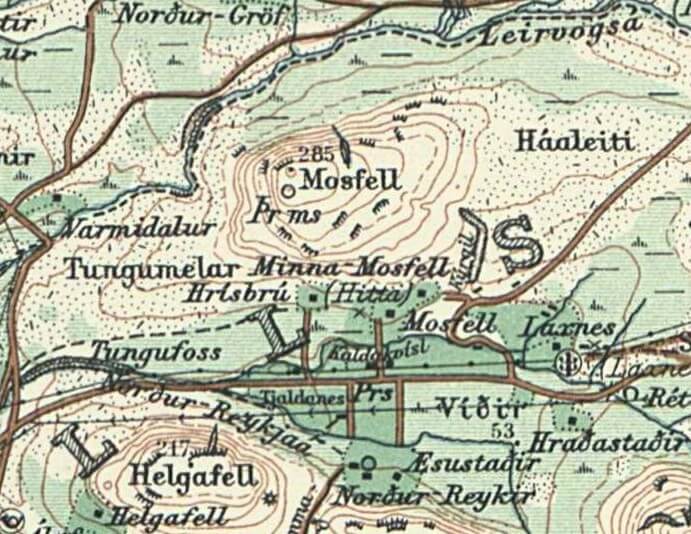
Egill Skallagrímsson lived in the tenth century and, according to the Saga of Egill, was a Viking warrior, skaldic poet, berserker, and sorcerer. As he felt death approaching, he took his silver and hid it somewhere on or near Mount Mosfell in Mosfellsdalur.
Most Icelanders can trace their family tree back to Egill Skallagrímsson. His father and grandfather, feuded with King Harald Fairhair of Norway and decided to leave for Iceland. Skallagrímur, Egills father, was among the first Norsemen to settle in Iceland, but Egill’s grandfather Kveld-Úlfur (Evening-Wolf) died at sea.
Egill composed his first skaldic poem at the age of three while drunk at a festive gathering. At seven he killed an older boy who had roughed him up when they were playing hockey, which met with his mother’s approval.
As young men, Egill and his older brother Þórólfur sailed from Iceland to raid and trade in Europe. This was called “going viking.” They and their men eventually signed up as fighters for King Æthelstan of England, like many of their kinsmen according to the Saga of Egill.
During the bloody Battle of Brunanburh in 937, Æthelstan achieved a decisive victory, thanks to the bravery of the brothers, according to theSaga of Egill, though Þórólfur fell in the fighting. As compensation, Æthelstan gave Egill one gold arm-band and two chests of silver, with instructions to share with his father and uncles. But Egill did nothing of the sort and kept it all to himself, moving the chests of silver with him wherever he went for the rest of his life.
After an eventful and violent lifetime, Egill who was by then blind and nearly deaf, went to live with his niece Þórdís at Mosfell. He confided in her his idea of going to Alþingi, Iceland’s annual outdoor assembly for legal and political matters, to ‘sow’ his silver by throwing it into the crowd, hoping fights would break out so he could hear the sound of battle one last time. However, his niece told her husband, Grim, a local chieftain (goði), who decided to go to Alþingi without Egill, thwarting the plan.
A bit later, Egill announced one evening that he was going out for a bath in the farm’s hot spring pool. Instead, he left on a horse with two slaves and the chests of silver. He returned the next morning with neither the slaves or silver. Shortly thereafter, he caught a fever and died.
Throughout the ages, there has been much speculation on where Egill’s silver might be hidden, and some attempts been made to find it. The Saga of Egill gives clues that it might have been hidden in a ravine east of Mosfell farm, thrown into earth holes, or sunk into the moors below. Furthermore, it states that some silver pennies were found in a ravine comming down Mount Mosfell, around the mid-13th century, shortly before the Saga of Egill was written down on vellum.
In 1725, there was another discovery of silver pennies in a ravine. The scribe who mentions it did not see the coins himself, but noted that he had been told they bore the inscription ANSLAFR. Much later, scholars made the connection that this was similar to how one of Æthelstan’s opponents, Olaf, had his name inscribed on his coins, ANLAF.
Archaeologists believe they have found where the old farm at Mosfell might have been located, under the slopes of Mount Mosfell in the land of Hrísbrú, one farm to the west of what is today Mosfell farm.
Should anyone go search for the silver around Mount Mosfell, there are two things to bear in mind: First, that it is polite to ask permission from the farmer or landowner. Second, if the silver is found, it should be reported to the National Museum of Iceland. A finder’s fee, a picture in the local papers, and a lifelong pass to the museum wouldn’t be too much to ask.