The Psychic Girl from Öxnafell
Margrét Jónsdóttir Thorlacius was born in 1908 into a poor but respected family. It soon became clear that she could see more than most people. She saw huldufólk and their dwellings, the spirits of deceased humans and animals, traveled outside her body, and could describe places she had never visited. She was also able to predict the future. Margrét became best known as a healing medium. Already in her early teens, people from North Iceland and beyond sought her out to deliver messages to Friðrik, a spirit healer from the other side with whom she worked.
Psychic abilities were known in her family line. Most notable was her paternal great-great-grandfather, Reverend Hallgrímur Thorlacius, priest of Mikligarður. She also said that some of her siblings were psychic but kept it to themselves.
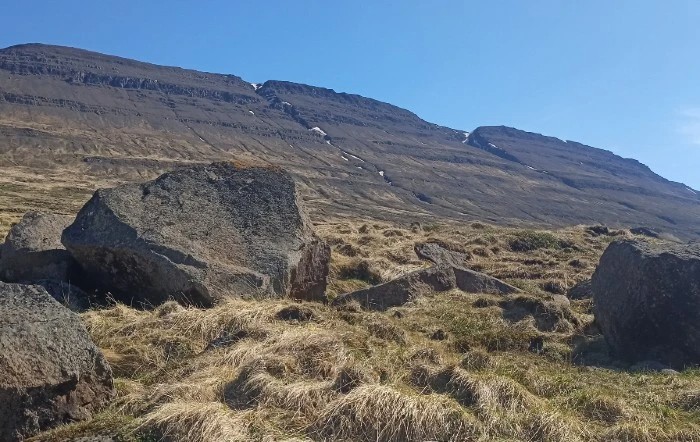
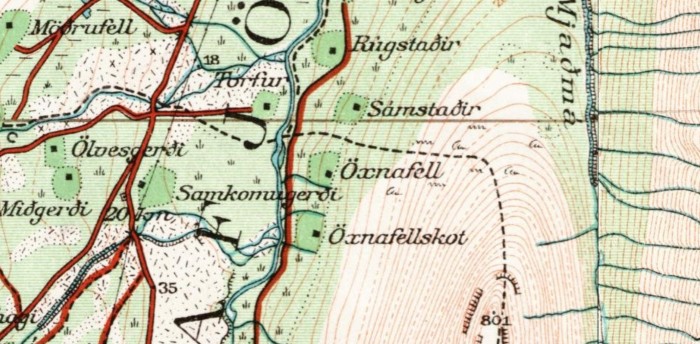
When Margrét was four years old, she began talking about the lights she saw in the mountain near the farm in the evenings, which she believed were the huldufólk turning on their lights. Her mother, Þuríður, saw nothing herself but didn’t correct her. As mentioned in the book Skyggna konan II (The Psychic Woman II), the second book published about her, others have also reported seeing unexplained lights in Eyjafjarðardalur valley.
When Margrét was five years old, she saw through clairvoyance that her lost lamb, Kolur, had died, and started crying. She was a great animal lover, and her mother said it was as if the animals could understand her. Margrét saw the spirits of farm animals after they had been slaughtered, and she was happy when she realized that they, too, had an afterlife, just like humans.
When she was a little older, she was given the task of driving the cows up the mountain. Her mother wondered why she was often gone so long and then learned that Margrét had met huldu children living in a belt of cliffs on the mountain and played with them. Later, Margrét said that when she reached a certain spot among the cliffs, a deep drowsiness would come over her before the visits began. From this, she concluded that she had not entered the home of the huldufólk children in her physical body.
It was among huldufólk that Margrét first saw Friðrik when she was about ten years old. She asked if he was one of the hidden people, and he answered that she could very well call him that, but later, at a séance, he said that he was a deceased doctor, without wanting to go into further detail.
Friðrik would take Margrét on flights in his flying boat, which is described in the book Skyggna konan (The Psychic Woman). He used to land it near the farm and would let Margrét know when he was ready for departure. On one occasion, she was asked that the next time she went on a flight, she should look back to see if she had left anything behind. When she returned from that trip, she said she had been quite astonished, because she had seen herself lying on the grass.
This seems to have been a form of out-of-body travel, and after Margrét’s abilities became known in the neighbouring farms, she was sometimes asked to use them to search for lost livestock. On one occasion, she searched for some sheep and described where she saw them. The farmer who had asked for her help claimed he had already thoroughly searched that area and did not believe her, but later he found the remains of the sheep where she had pointed.
On another occasion, she was searching for runaway horses but could not find them. Instead, she saw some sheep that struck her as strange, they were white except for their black heads. Later, those sheep turned up during searches.
Around the time Margrét met Friðrik, her mother was very ill, and she asked him if he could help. Friðrik responded positively and appeared in a white doctor’s coat. Her mother recovered quickly and went on to live for about sixteen more years.
Margrét’s relationship with the hidden doctor gradually became known, and by the time she was sixteen years old, a steady stream of people were coming to the farm seeking healing, more often asking for help on behalf of others. She also received hundreds of letters.
It was at that time, in 1924, that Einar Hjörleifsson Kvaran, a writer, editor, and leading figure in the spiritualist movement, discovered her and wrote about her in Morgunn, the magazine of the Theosophical Society of Reykjavík, and she became known nationwide. At the age of seventeen, she went to the capital and stayed with the Kvaran couple for one winter. She went there to seek healing and to have her abilities examined. Kvaran explained that Margrét needed to seek help elsewhere rather than from Friðrik, because if mediums healed themselves, they would lose their ability.
Kvaran’s conclusion was that Margrét possessed great and varied psychic abilities, but that as a healing medium she still had room to mature. He was committed to having psychic phenomena studied in a scientific manner and seems to have tried to separate them from old-fashioned folk beliefs. He suggested to Margrét that it was not huldufólk she was seeing, but rather the spirits of the deceased, or that it was a case of clairvoyance. However, Margrét never accepted that.
In addition to huldufólk, she also saw elves, but she made a clear distinction between the two. In her view, huldufólk were very similar to humans, only often more beautiful. Elves, on the other hand, were small and mostly stayed around vegetation, and were about 30 to 40 centimeters tall. She also saw flower elves, which were even smaller. After she moved to Reykjavík, where she lived for a time, there was a house elf in the garden who later moved into the living room and hid behind a houseplant. She also saw air spirits, nature spirits, and sometimes received visions involving mysterious beings and beautiful natural scenery.
Margrét saw human radiance, what is today called an aura. This proved useful to her after her eyesight began to deteriorate as a result of her illness, as she could often recognize people by their aura before she could distinguish them by sight. She also possessed the rare ability to hear different tones and melodies connected to different handwriting. Some were accompanied by delicate tones, others by rougher ones. She believed she had lived before and received visions from past lives in Egypt and France. She had a fear of water, which she connected to a past life in which she had drowned while traveling from France to England.
As an adult, Margrét once assisted in the search for two pilots who had crashed. She was able to describe to the searchers the location where they were. One of the pilots, whom she knew, later said that he had dreamed of her at the same time that she was trying to make contact with him.
In Akureyri, Margrét took part in the work of the Theosophical Society of Akureyri, the oldest society of it’s kind in the country, and other organizations devoted to spiritual studies. There she met Eiríkur Sigurðsson, a school principal who collected stories about her and Friðrik for the book Skyggna konan (The Psychic Woman), which was published in 1960 and became a bestseller. A second volume, Skyggna konan II (The Psychic Woman II), followed in 1963. These books contain numerous accounts from people who believed they had benefited from Friðrik’s healing, although according to Eiríkur, they represent only a small and random selection of the actual cases.
Interest in spiritualism had declined after the deaths of Einar H. Kvaran and Haraldur Níelsson, another leading figure in the spiritualist movement, and fewer people sought out Margrét, though there was always some demand. Better medicines and other advances in medical science likely played a role as well. With the publication of the books Skyggna konan (The Psychic Woman) and Skyggna konan II (The Psychic Woman II), she became nationally famous again, and people began seeking her help as much as they had when she was a teenager at Öxnafell. She received people at home, and recieved countless letters, telegrams, and telephone calls. She never asked for payment for her help, even though it amounted to full-time work, but she accepted voluntary donations.
Although her encounters with hidden beings were usually positive, that was not always the case. On one occasion, when she was living in Akureyri, a woman who practiced spirit writing contacted her and invited her for a visit. Friðrik told her not to go, but she went anyway. At the woman’s home, she saw low and immature beings that scared her, and some of the spirit writing turned out to be false messages supposedly from Friðrik. At other times, when she saw low and unfriendly beings, they were usually in the company of drunk people.
When Friðrik appeared at a séance with Einar Kvaran, he described his collaboration with Margrét by saying that her role was to connect him with the patients who needed healing, and that from her he also received energy, which made it possible for him to work.
The requests that Friðrik received through Margrét were of the same kind and just as varied as those ordinary doctors receive. Often he was able to help, but there were also times when he told Margrét that the illness was incurable, and in some cases only palliative care was possible. When she was a teenager, Margrét sometimes stated bluntly if a patient could not be saved, but later she stopped doing that and preferred to say nothing. Friðrik admitted that he could not help with everything and sometimes referred patients to a living doctor, for example if surgery was needed.
The medical visits of Friðrik, and later other spirit doctors who joined him, were experienced by patients in various ways. He seemed to come mostly in the evenings or at night, and most often those he visited were unaware of his presence. Sometimes they dreamed of him, felt his presence, or felt hands on them, and occasionally the treatment was painful. In rare cases, patients experienced his visit as they would that of any other doctor and had full communication with him. Sometimes instruments were used during treatment, such as poultices, needles, or other devices. On one occasion, relatives noticed a strong smell of medicine at the time he was visiting. On another occasion, a woman saw something like fast, white northern lights moving above the bed of a boy who was sleeping in the same room as the woman Friðrik had been asked to visit. The books describe many cases where living doctors were astonished at how quickly a patient recovered, even when they had believed there was little or no hope the patient would survive.
Already during her teenage years, some asked if she might simply be mentally ill, and in our time, it is very likely that her visions and psychic hearings would have been dismissed as symptoms of mental illness and she would have been put on strong psychiatric medication. Had she been born a century or two earlier she might have been treated like an outcast or worse. But instead, she found a place in society where she was respected and lived a successful life.
Sources in English
Sources in Icelandic
- Dulskynjanir III. Sálrænar lækningar. Morgunn, 1. júní 1977
- Einar Hjörleifsson Kvaran. Lestu
- Hverjir voru miðlarnir? Morgunn, 1. júní 1998
- Margrét Thorlacíus í Öxnafelli. Morgunn, 1. desember 1926
- Skyggna konan (1960). Eiríkur Sigurðsson
- Skyggna konan II (1963). Eiríkur Sigurðsson
- Skyggna stúlkan í Öxnafelli. Morgunn, 1. desember 1924