Foreman Þuríður
In 1827, a robbery was committed at the farm Kambur in Flói, which caused widespread unease among Icelanders. It was later often mentioned alongside two other infamous criminal cases of the 19th century: the murders at Sjöundá, committed in 1802, and the murders at Illugastaðir in 1828. The investigation of the Kambur robbery and the subsequent trial became the most extensive in Icelandic history up to that point.
In the investigation of the robbery, the district commissioner received assistance from a woman named Þuríður Einarsdóttir (1777–1863), known as Foreman Þuríður. The commissioner had specific suspects in mind, but it is unlikely the case would have been solved without her. Þuríður employed methods similar to those being developed by European pioneers in the fields of criminal and forensic investigation at the time. It is safe to call her Iceland’s first private detective, a rare role in Iceland’s history. Although no records exist of her involvement in other criminal investigations apart from defending herself against slanderous personal attacks, she seemed to be very much on the same wavelength as Eugène François Vidocq (1775–1857), who was almost her exact contemporary. Born two years earlier than Þuríður, Vidocq is regarded as the father of modern detectives and criminology.
It was pitch dark, with high winds and heavy rain, on the night of February 9, 1827, when four masked men broke into the Kambur farm and forced their way into the living quarters. There, the farmer, a housekeeper, a maid, and a five-year-old boy lay naked in their beds. The robbers tied them all up and threatened them with murder and torture unless they revealed where the farmer’s money was hidden.
The farmer suffered the worst treatment, his fear rendering him unable to speak. The maid, after asking if the intruders were men or demons, was told they were sent from heaven to collect the farmer’s money. She eventually revealed that the money was buried under the lamb pen, which the robbers searched. They also dragged the household members onto the floor, rummaged through the beds and fireplace, and broke into every cupboard and chest.
The robbers escaped with approximately 1,000 rigsdaler, equivalent to around one million ISK today, or approximately 7,000 USD/EUR. As they departed with their loot, the household overheard them arguing about whether to set the farm on fire.
When Þórður Sveinbjarnarson, the district commissioner of Árnessýsla, and his assistant Jón Jónsson arrived the following day to question witnesses, the women reported smelling the scent of burned seaweed on the robbers’ leather clothing. Based on this detail, along with a shoe found in the direction of the sea, the commissioner decided they should ride to Stokkseyri. They arrived just as church service ended and positioned themselves outside the church to observe the reactions of the locals. They particularly noted two men: Jón Geirmundsson, who appeared visibly startled, and Sigurður Gottsvinsson, who gave them a hostile glare.
But apart from that and a few items the robbers had left behind, there wasn’t much to base the investigation on. Thus, the district commissioner decided to seek help from the locals. He first approached Jón at Móhús, the district leader, who declined, fearing it would make him unpopular if he implicated his neighbors in the crime. However, he pointed to Þuríður Einarsdóttir, who had previously been a deckhand on his boat, describing her as observant and perceptive.
Þuríður was then a boat foreman on an eight-oared vessel. She was already a renowned seafarer and respected by other foremen, consistently ranking among the most successful in each fishing season, despite having a smaller boat than many others. She began fishing at the age of eleven, and while it was not unheard of for women to work at sea, it was unprecedented for a young girl to do so.
Her time at sea shaped her personality and manner of speaking. She communicated in short, precise sentences—a habit forged by the demands of life at sea, where the sound of the sea and wind, combined with the urgency of tasks, made clear communication essential. She also developed a sharp eye for weather patterns and natural signs, skills that helped her locate the best fishing spots.
Þuríður was also reluctant to help, much like Jón, but the district commissioner had leverage over her. She habitually wore men’s clothing in her daily life, a practice she had adopted when she began working at sea. The commissioner informed her that wearing such attire required permission from the king, and he claimed he could secure that permit for her if she agreed to assist. It is not mentioned what punishment he might have threatened her with had she refused.
The robbers had meticulously planned their crime, even going so far as to call each other by the names of local men during the robbery to mislead witnesses. As was later revealed, they had also scouted the area beforehand to assess the conditions. However, their downfall ultimately came from a few items they left behind, which Þuríður carefully investigated. These included the shoe found near Kambur, an iron rod used to break into the farm, an old hat, and a mitten.
Þuríður examined the craftsmanship of the shoe and identified three farms where housewives knew how to make such shoes. One of these was the home of Jón Geirmundsson, the man who had appeared startled outside the church. She visited Jón, urging him to confess promptly if he was guilty. While there, she discreetly inspected Jón’s smithy and noticed a blemish on the anvil that matched a mark on the iron rod left at the scene.
But she found it unlikely that Jón had been the leader of the group. Instead, she immediately suspected that it might have been Sigurður Gottsvinsson. Sigurður had served as her deckhand for one fishing season, and although she described him as the best sailor she had ever worked with, she had refused to hire him again because of his character and the negative influence he had on others in the crew.
Þuríður also informed the district commissioner that the old hat closely resembled one worn by Sigurður Gottsvinsson’s son the previous year. Shortly afterward, Sigurður confronted her and threatened to kill her if she implicated him in the case. Rumors linked his father to several murders, so Þuríður took the threat seriously. She requested Sigurður’s arrest, and he was taken into custody.
A man named Jón Kolbeinsson was a deckhand with Þuríður during that fishing season. After the investigation began, his brother Hafliði approached Þuríður and asked for a place on her boat, a request she granted. It was later revealed that Hafliði was one of the robbers. Jón, meanwhile, began following Þuríður closely whenever they were ashore. His behavior quickly aroused her suspicion and made her feel threatened.
The mitten found at the scene was displayed for viewing at Kambur, and after Þuríður willingly mentioned it in Jón’s presence, it disappeared after his visit to the farm. Ultimately, it was revealed that Jón was also one of the robbers.
Jón Geirmundsson admitted his guilt after Þuríður assured him that being the first to confess would be taken as a mitigating factor. She also promised to care for his daughter if he ended up in prison. In time, all the robbers confessed, with Sigurður Gottsvinsson being the last to do so.
The investigation lasted 11 months, involved 52 court sessions, and brought 30 individuals to trial. It ultimately uncovered a gang of thieves who had been stealing from local farmers and the merchant in Eyrarbakki.
The fate of the four robbers was decided in 1829 when they were convicted and sent to Denmark to serve their sentences. The punishments varied in severity: Sigurður was sentenced to flogging, branding, and lifelong forced labor. Jón Geirmundsson received flogging and a sentence of lifelong forced labor. Jón and Hafliði Kolbeinssons were sentenced to 12 and 8 years of hard labor, respectively.
In 1844, they were granted royal pardons, except for Sigurður, who was beheaded for attacking a prison guard. Considering his violent end, one might wonder if Sigurður’s fate was inevitable. He was the son of known thieves, recieved beatings from his drunk father as a child and his mother herself claimed in old age that, while pregnant with him, she promised him to the devil in exchange for his father escaping punishment for theft.
This wasn’t the first time Þuríður employed undercover tactics; she had previously done so to defend her own reputation. For eleven fishing seasons, she served as a deckhand on Jón at Móhús’ boat before leaving to become a foreman on another. Jón, unhappy with her departure, retaliated by commissioning defamatory verses about her, instructing sailors to recite them at sea so that Þuríður and her crew would hear them.
Þuríður discovered that the verses had been distributed on paper and, through cunning, managed to obtain a copy. She used it as evidence to file a lawsuit against Jón. Although the case ended in a settlement relations between them were never fully repaired. Jón also did her a disservice by pointing her out to the district commissioner, fully aware that it could make her unpopular among the locals. Þuríður initially tried to conceal her assistance by arranging for the commissioner to summon her for questioning along with the suspects, but the subterfuge soon became evident.
As previously mentioned, Þuríður feared for her life during the investigation of the Kambur robbery, due to Sigurður Gottsvinsson’s threats and Jón Kolbeinsson following her. However, the danger did not end with their imprisonment. Many years later, someone fired a shot into her sleeping quarters, the bullet passing over her as she lay beneath the window.
It was never revealed who was responsible or whether the attempt was connected to the Kambur robbery, or personal animosities. Þuríður had been involved in many disputes and had filed complaints against several individuals for slander, including accusations that she was bisexual.
Although Þuríður was ahead of her time in reasoning and investigative skills, she believed in and was haunted by a ghost from her family’s past. Known as Sels-Móri, he was said to be the spirit of a wandering boy who perished after her father refused him shelter. Following his death, the ghost reportedly attached himself to her family and was blamed for the death of her brother.
Þuríður also held Móri responsible for her misfortunes in love, having endured several failed relationships. One marriage ended after her husband’s sister spread lies about her infidelity while Þuríður was pregnant with their daughter. The sister’s motivation was to avoiding association with what she believed to be a cursed lineage. Tragically, Þuríður’s daughter died at the age of five.
The robbery and Þuríður’s role in solving it were chronicled by Brynjólfur frá Minna-Núpi in a book, which, if rendered into English, would be titled The Story of Foreman Þuríður and the Kambur Robbers. She became a folkloric figure during her lifetime, and her name has since been given to a ship, a football team, a band, and a women’s labor union. Additionally, a rock formation near Knarrarós is named Þuríðarhella in her honor.
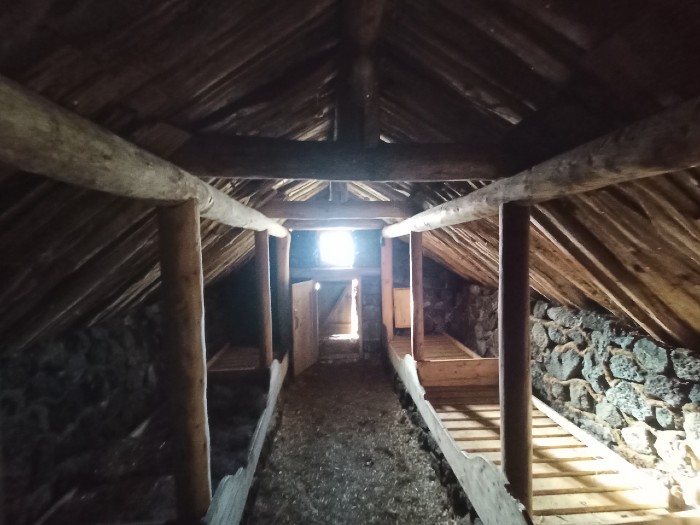
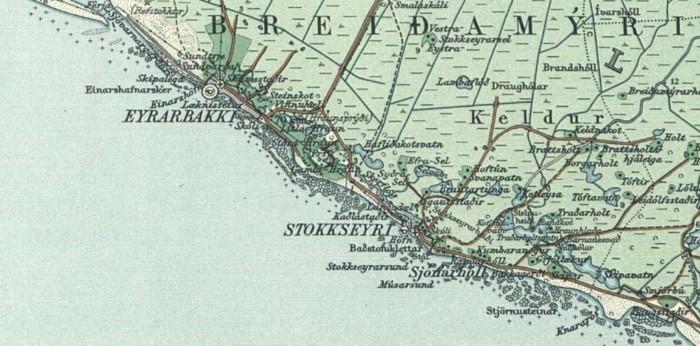
In Stokkseyri, a replica of Þuríður’s fisherman’s hut, known as Þuríðarbúð, stands today as part of the local heritage museum. While it may not share the global fame of Sherlock Holmes’s apartment at 221B Baker Street in London, it is nonetheless a site worth visiting.
Sources in English
- Eugène François Vidocq. Wikipedia
- Foreman Thuridur. Wikipedia
- Woman, Captain, Rebel (2023). Margaret Willson
Sources in Icelandic
- 150 ár frá Kambsráni. Þjóðviljinn, 9. febrúar 1977
- Kambsránið. Wikipedia
- Lítið ágrip ævisögu minnar. Saga Þorlákshafnar II (1988) – Þuríður Einarsdóttir
- „Meykóngur“ og þjóðsagnahetja: Sagnir og samtímaheimildir um Þuríði Einarsdóttir (B.A. verkefni 2002). Sandra Sif Einarsdóttir
- Ránið, markið og rjólbitinn. Fréttabréf Ættfræðifélagsins, febrúar 2011
- Sagan af Þuríði formanni og Kambsránsmönnum (1975). Brynjólfur Jónsson
- Scotland Yard á Stokkseyri. Vikan, 21. apríl 1960
- Þáttur af Sigurði Gottsvinssyni. Lesbók Morgunblaðsins, 30. janúar 1993
- Þuríðarbúð á Stokkseyri. Lesbók Morgunblaðsins, 17. júlí 1949
- Þuríður formaður. Wikipedia
- „Þuríður snarast þóftu á mar…“ Fiskifréttir, 6. júní 1986